Claude Sonnet 4.6: A High-Performance AI Available Even on the Free Plan
Table of contents 20 items
On February 17, 2026, AI company Anthropic released a new model called Claude Sonnet 4.6. It is available immediately on the free plan, ships with a meaningful jump in quality over its predecessor, and broadens the range of business tasks Claude can realistically handle.
This article covers the basics of Claude, what changed with Sonnet 4.6, and how non-engineer business teams can put it to work — written so you don’t need any technical background to follow along.
What is Claude in the first place?
Claude is an AI assistant developed by Anthropic. Alongside ChatGPT and Gemini, it is one of the major general-purpose AI services, and it handles a wide range of office work — drafting and summarizing documents, research, data analysis, and more.
Claude comes in three model tiers, each playing a different role:
| Model name | Position | Characteristics |
|---|---|---|
| Opus | Top-tier model | Highest quality. Best for complex analysis and high-stakes judgment. |
| Sonnet | Workhorse model | Balanced quality and speed. The daily driver. |
| Haiku | Lightweight model | Very fast. Best for simple questions and high-volume processing. |
Sonnet is the model most people use day-to-day, and it just got an upgrade. Anyone — free or paid — can use it right now at Claude.ai.
What changed in Sonnet 4.6
Roughly 70% of users prefer it over the previous version
According to Anthropic’s own testing, about 70% of users prefer Sonnet 4.6 over Sonnet 4.5. Even more striking: 59% of users prefer Sonnet 4.6 to Opus 4.5 (the November 2025 top-tier model).
In other words, the workhorse model has overtaken last generation’s flagship — an unusual leap forward.
What specifically got better
Here are the improvements, mapped to what they mean in the context of business work:
| Improvement | What changed | Why it matters at work |
|---|---|---|
| Better instruction following | More accurately reflects what you asked for | Less of “I asked for X, but it gave me Y” |
| Fewer fabrications | Hallucinations (plausible-sounding but false output) reduced | More trustworthy for research and reports |
| Less over-elaboration | Stops volunteering things you didn’t ask about | You get only the information you actually need |
| Stable on multi-step work | Better at carrying through “first do A, then compare to B, then summarize” workflows | Quality holds up on longer, more complex requests |
| Stronger defenses against prompt injection | Significantly hardened against attacks where a third party hides malicious instructions | Safer to use on real business content |
| 1M-token input context | Context window expanded to 1 million tokens (general availability March 13, 2026) | Long contracts and entire document sets can be processed in one shot |
The performance gains in numbers
AI capabilities are measured via benchmarks (standardized tests). Sonnet 4.6 set new records on several of them.
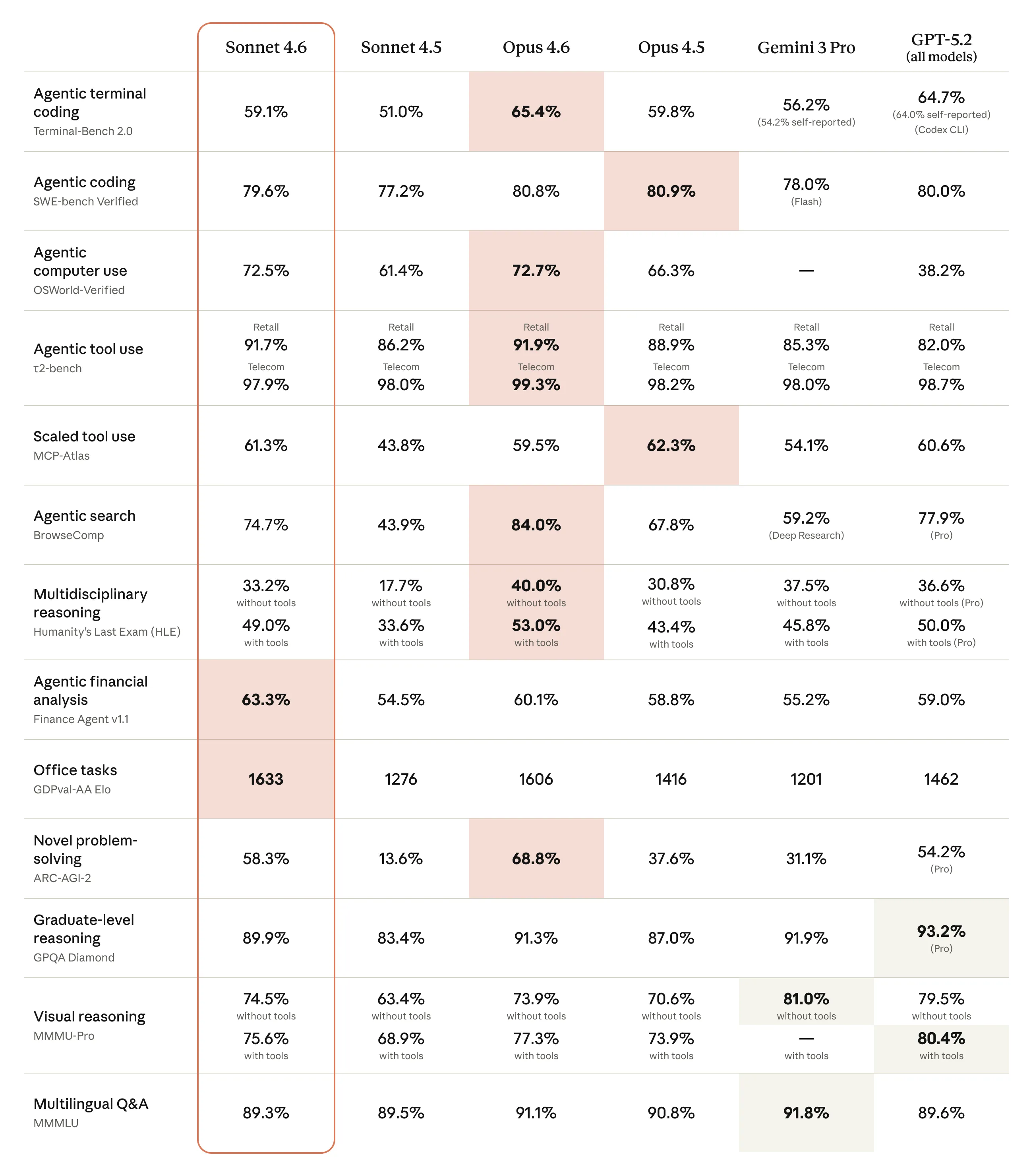 Sonnet 4.6 across various benchmarks. It exceeds the previous version on most metrics. (Source: Anthropic blog)
Numbers worth highlighting
- Box’s enterprise document benchmark: 77% accuracy on advanced QA (up from 62%, a 15-point gain)
- Enterprise document understanding (OfficeQA): comparable to top-tier Opus 4.6
- Pace (insurance industry) evaluation: 94% accuracy on a real business benchmark
Major progress on computer-use automation
On computer-use tasks — where the AI operates a PC on a human’s behalf — Sonnet 4.6 also set a new record.
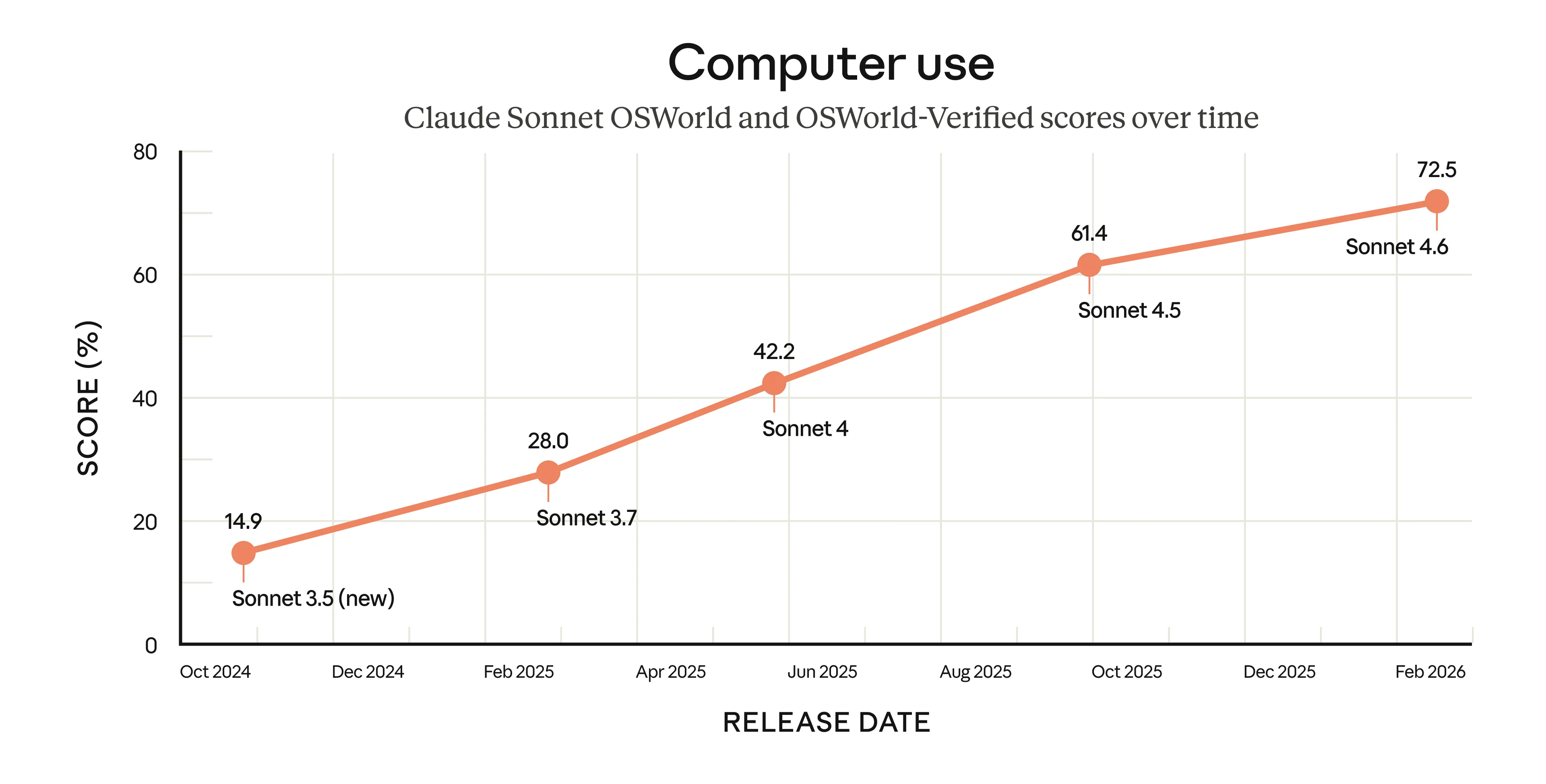 OSWorld benchmark, which measures computer-use automation. Sonnet 4.6 set a new high. (Source: Anthropic blog)
Especially notable: hallucinated browser actions — clicking on links that don’t exist — dropped from 33% in the previous version to 0%. This directly improves the reliability of agentic workflows where the AI is asked to gather information or operate files in a browser on its own.
Stronger at planning and execution
Sonnet 4.6 also performs strongly on tests that measure complex, multi-step planning and execution.
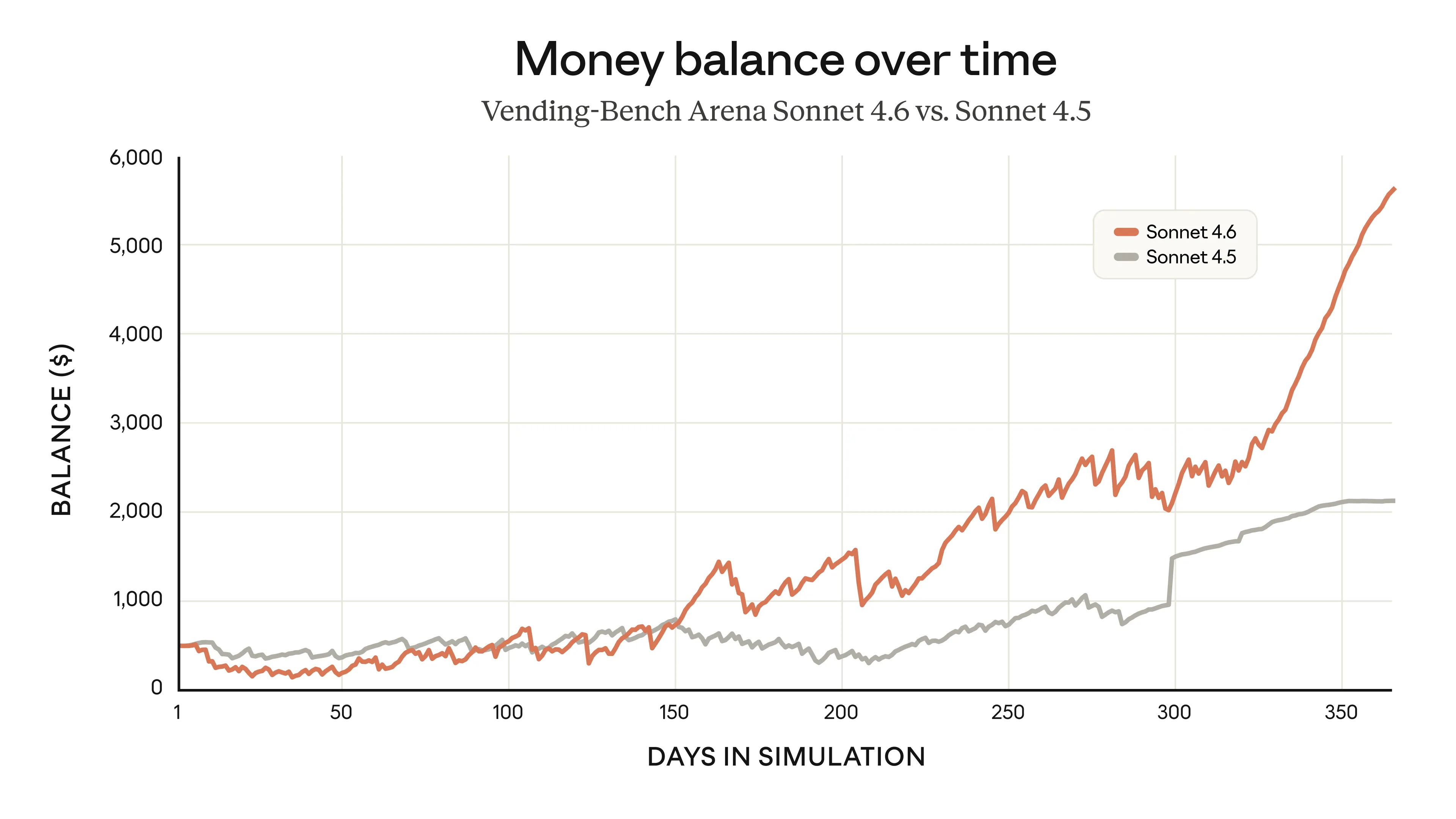 Vending-Bench Arena, which measures the ability to plan and execute complex tasks. (Source: Anthropic blog)
Sonnet 4.6 vs Opus 4.6 — how big was the gap to the then-top-tier model?
When you compare Sonnet 4.6 against Opus 4.6 — which was the top-tier model at the time of this article’s release — the differences on most metrics are small (note: as of June 2026, Opus 4.8 is the current flagship). On several business-flavored tasks, Sonnet 4.6 actually edges out Opus 4.6.
| Test | Sonnet 4.6 | Opus 4.6 | Difference |
|---|---|---|---|
| Advanced reasoning (GPQA)※1 | 89.9% | 91.3% | -1.4 |
| Math (MATH-500) | 97.8% | 97.6% | +0.2 |
| Knowledge (MMLU-Pro) | 79.1% | 81.2% | -2.1 |
| Computer use (OSWorld) | 72.5% | 72.7% | -0.2 |
| Customer support — retail (TAU-bench) | 91.7% | 93.5% | -1.8 |
| Customer support — telecom (TAU-bench) | 97.9% | 97.9% | tied |
| Office work (GDPval-AA) | 1633 | 1559 | +74 |
| Financial analysis (Finance Agent) | 63.3% | 62.0% | +1.3 |
| Tool use (MCP-Atlas) | 61.3% | 60.3% | +1.0 |
※1 The GPQA score is with extended thinking enabled. Without extended thinking, Sonnet 4.6 scores 74.1% on GPQA. Note that starting with Opus 4.7 (released April 16, 2026), Anthropic dropped extended thinking in favor of Adaptive Thinking — Claude decides whether and how much to think on its own. That approach carries over to the latest flagship, Opus 4.8 (released May 28, 2026). Sonnet 4.6 continues to support extended thinking.
The bolded rows are tests where Sonnet 4.6 actually beats Opus 4.6. On business-flavored tasks like office work and financial analysis, the workhorse model outperformed the then-flagship Opus 4.6 — which is part of why Sonnet 4.6 is such a strong default for daily work.
Pricing and access — free to try right now
Plans
Sonnet 4.6 is available on Claude.ai’s free plan. Sign up for an account and you can start using it immediately.
| Plan | Price | Sonnet 4.6 access |
|---|---|---|
| Free | $0 | Available (with rate limits) |
| Pro | $20/month | Higher message allowance |
| Max 5x | $100/month | 5× the Pro allowance |
| Max 20x | $200/month | 20× the Pro allowance |
| Team Standard | $25/seat/month | Admin features, team-oriented |
| Team Premium | $125/seat/month | Larger allowance and advanced admin features |
| Enterprise | Contact sales | Stronger security and management |
Where you can use it
Sonnet 4.6 is available on the following platforms:
- Claude.ai — directly in your browser (all plans)
- Claude Cowork — desktop business automation
- Claude Code — coding-focused tool for development teams
- Amazon Bedrock — for companies on AWS
- Google Cloud Vertex AI — for companies on Google Cloud
If you already run on AWS or Google Cloud, you can use Claude through your existing environment.
What it looks like in business use
Sonnet 4.6’s improvements translate directly into better day-to-day output across departments.
Sales
- Pre-meeting research: pull recent news and industry context on a target account and summarize the key points.
- Proposal drafting: turn a customer’s stated problems into a proposal outline or first draft.
- Email drafting: write follow-up notes and outreach in the right register.
- The improved instruction-following means it now handles fine-grained directions (“warmer tone”, “emphasize this point”) accurately.
Finance / accounting
- Aggregation and analysis: trend analysis on sales data, organizing data for charts.
- Report drafting: monthly reports, budget-vs-actual narratives.
- Reading regulations and notices: summarizing internal policies or tax-law changes.
- With fewer hallucinations, it’s more trustworthy on number-driven work.
Legal
- Pulling key clauses out of contracts: surface risks and important provisions from long contracts.
- Comparing terms of service versions: spot what changed between an old and new version.
- Summarizing law changes: explain new rules in plain language.
- The improved stability on multi-step work means a single prompt like “read this contract, list the risks, and propose responses” is now realistic.
HR / general affairs
- Drafting internal documents: manuals, FAQs, internal newsletter articles.
- Streamlining inquiry responses: building reusable answer templates.
- Translation and multilingual work: documents for overseas offices, materials for non-Japanese-speaking employees.
The Claude model lineup in context
Sonnet 4.6 is part of Anthropic’s February 2026 update wave.
| Model | Release date | Status |
|---|---|---|
| Opus 4.8 | May 28, 2026 | Released. Latest flagship. Selectable on Pro and above. |
| Opus 4.7 | April 16, 2026 | Released. Previous generation. Still selectable. |
| Opus 4.6 | February 5, 2026 | Released. Older generation. Still selectable. |
| Sonnet 4.6 | February 17, 2026 | Released. The subject of this article. |
| Haiku 4.5 | October 15, 2025 | Released. Lightweight tier. |
Anthropic has shipped Opus and Sonnet updates back-to-back since February — a noticeable acceleration. The April 16, 2026 Opus 4.7 release brought a large jump in software engineering performance, and on May 28, 2026 Anthropic followed up with Opus 4.8, an even more capable flagship. Opus 4.8 is available on claude.ai (Pro and above) and via the Claude API (model ID claude-opus-4-8), among other platforms.
Wrap-up — “the AI that actually works” just got better again
Claude Sonnet 4.6 is a clear step forward over the previous version. The headline improvements:
- It does what you asked more reliably
- Made-up information has dropped sharply
- Complex requests hold together better end-to-end
- Safety is meaningfully stronger
- Free plan access — you can try it today
If you have been meaning to bring AI into your work but haven’t yet, a free Sonnet 4.6 account is a good starting point. Open Claude.ai and try it on whatever is annoying you about your current workflow — “rewrite this email”, “summarize this document”, anything close at hand.
For a beginner’s walkthrough see Claude (Anthropic) — A Beginner’s Guide for Non-Engineers, and for plan-by-plan rate limits see Claude Usage Limits Explained.
(Information current as of June 2026. Features and pricing may change.)
References
Was this article helpful?